Production and warehouse floors
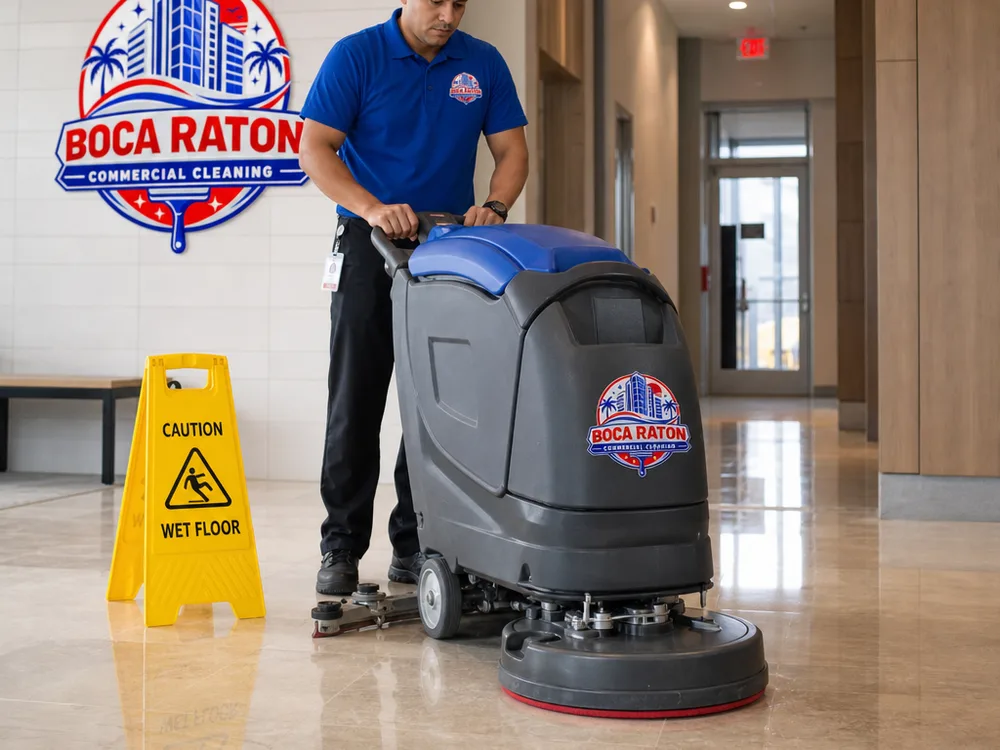
Machine scrubbing on concrete and sealed surfaces, with attention to turn areas, aisle intersections, and the tire marks that make a clean floor still look neglected.
Serving Boca Raton, Florida & surrounding areas
Mon–Fri 8am–6pm · Sat 9am–2pm
Industrial Cleaning · Boca Raton
Warehouse floors, production areas, loading docks, and the overhead surfaces that quietly collect dust until an inspection puts them on a list.
Industrial sites do not need a nightly tidy. They need dust controlled, floors safe, and work scheduled around production.
Heavier environments
An industrial space fails a cleanliness check in different places than an office does. It is rarely the desks. It is the dust that settles on racking beams and light fixtures, the tire-marked concrete where forklifts turn, the residue built up around a machine base, and the dock apron nobody has pressure cleaned since the building changed tenants.
Those areas need different equipment and a different schedule. Ride-on scrubbers instead of mops, extension work for anything above head height, and crews who plan around a production run rather than expecting an empty building at six o'clock.
We service industrial bays and flex space across the Arvida Park of Commerce, the warehouse strips off Congress Avenue, and the light manufacturing and distribution units west of I-95, where dock doors stay open through the day and outside dust and humidity come in with everything else.
Where a site has both a plant floor and front offices, the two get separate scopes. Trying to run one checklist across both is how the offices end up under-serviced and the plant floor over-promised.
Industrial scope
Machine scrubbing on concrete and sealed surfaces, with attention to turn areas, aisle intersections, and the tire marks that make a clean floor still look neglected.
Dock aprons, levelers, bumpers, and the strip just inside the door where grit, spilled product, and weather collect together.
Racking beams, ledges, pipe runs, and light fixtures cleared of settled dust using the right access equipment rather than a ladder and optimism.
The floor and structure around machine bases, where residue builds into a slip risk and an inspection finding at the same time.
Locker rooms, break areas, and restrooms that see work boots and heavy use, cleaned to a standard that accounts for the soil actually arriving.
The office portion handled on its own checklist, including the glass partitions between plant floor and office that show every fingerprint.
Working around production
Very few industrial sites can hand over an empty building. Most run a shift pattern with a window between them, and that window is where the heavier work belongs: scrubbing, dock cleaning, and anything requiring equipment that cannot share an aisle with a forklift.
Lighter work fits inside operating hours. Restrooms, break areas, office zones, and trash removal can run while production continues, provided the route avoids active bays and the crew follows your site rules on protective equipment.
Some tasks are better treated as scheduled projects than as part of a weekly visit. High dust clearing, pressure cleaning of dock areas, and full floor restoration are disruptive enough that they deserve their own date and their own preparation.
Humidity works against you on the coast. Condensation on cool surfaces holds dust in place rather than letting it blow off, so a Boca Raton site usually needs its high work on a shorter cycle than the same building would inland.
We walk the floor during a working shift, because an empty building hides the traffic patterns and the residue sources that decide the scope.
We confirm protective equipment rules, lockout expectations around machinery, contractor induction, and which areas crews may never enter unescorted.
Plant floor, dock, staff areas, and offices each get their own task list and frequency, so nothing is averaged into a single vague promise.
We agree the shift window for heavy work, run the first cycle with a supervisor present, and adjust the plan against what the site actually produces.
Cost drivers
Industrial cleaning is usually priced per project or per shift rather than per square foot, and commonly lands between about $0.08 and $0.25 per square foot for recurring floor work, with one-time deep or high-level cleaning quoted separately. Access requirements move the number more than area does.
The largest variables are how much of the work needs equipment, how much needs elevated access, and how tight the shift window is. A site that can release an aisle for four hours costs less to service than one where every pass has to work around live traffic.
Common questions
Lighter work such as restrooms, break areas, offices, and trash removal runs during operating hours without difficulty. Floor machine work, dock cleaning, and elevated dust clearing need a shift gap or a released zone, which we schedule with your operations lead.
Yes, crews work to your site requirements on protective equipment, restricted zones, and escort rules, and we complete contractor induction before the first visit if you run one. Tell us about lockout procedures around machinery during the walkthrough so the scope respects them.
We handle racking beams, ledges, pipe runs, and fixtures reachable with standard commercial access equipment. Anything requiring a boom lift, roof access, or confined-space entry is quoted separately and coordinated rather than attempted on a regular visit.
Machine scrubbing with the correct pad and chemical removes most forklift marking and general soil from sealed concrete. Deeply embedded staining in unsealed concrete may lighten rather than disappear, and we say so before the work rather than after.
Yes, and it gets its own checklist rather than being folded into the plant floor scope. The two areas soil at completely different rates, so one combined frequency always shortchanges one of them.
Yes, one-time work is common ahead of an inspection, an audit, a lease handover, or a shutdown week. We quote it as a project with a defined scope and a target completion, separate from any recurring service.
Scope it properly
Tell us your site type, floor area, and the shift window you can release. We will walk the floor during a working shift and quote each zone separately.
Request a quote
Send the size, type of building, and how often you need service. We reply with a written scope and a price, and we will walk the site before anything is agreed.