
Entries, matting, and transitions
The first ten feet inside your door treated as the priority it is: mats lifted and cleaned underneath, thresholds detailed, grit removed before it reaches carpet.
Serving Boca Raton, Florida & surrounding areas
Mon–Fri 8am–6pm · Sat 9am–2pm
Serving Deerfield Beach, FL
Offices along the Hillsboro corridor, flex and warehouse space west of the highway, and the sand that reaches carpet a long way from the water.
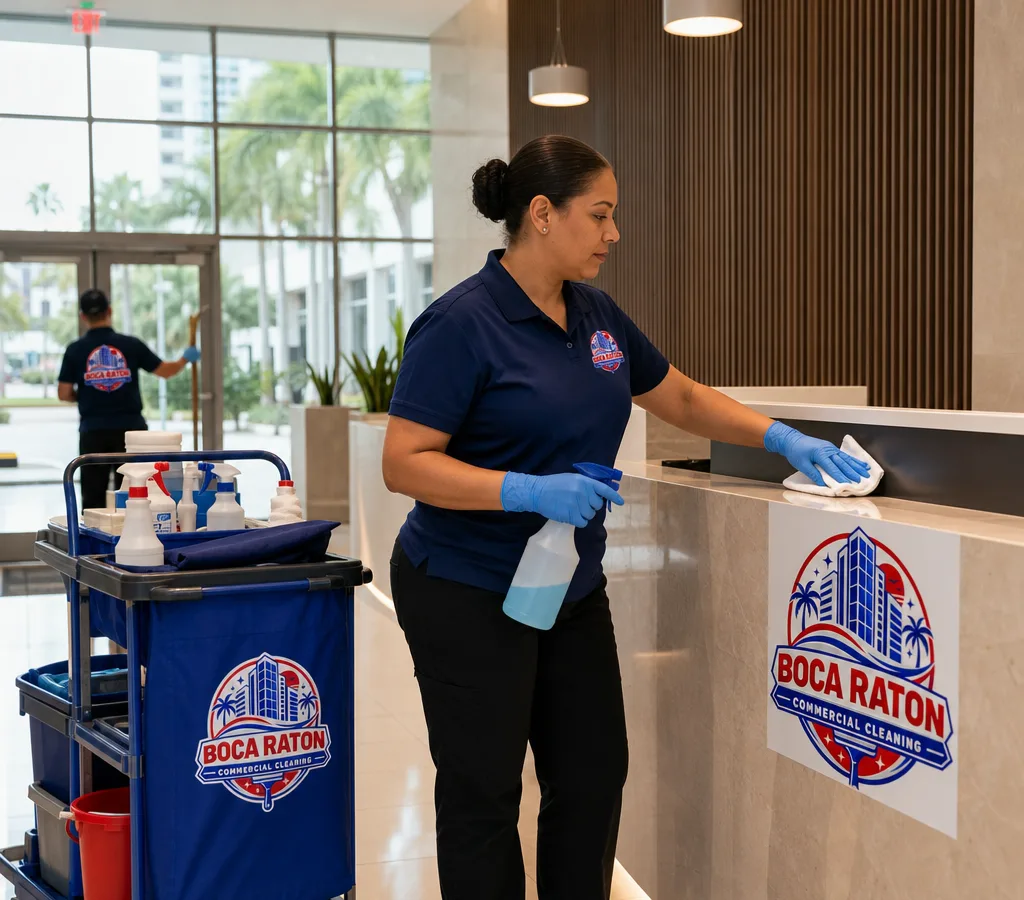
Sand is abrasive. A floor that is only ever swept gets sanded a little more every week until the finish is gone.
The first ten feet
Deerfield Beach buildings share a problem that has very little to do with how tidy anyone is. Sand travels. It arrives on shoes from the beach, from parking lots, and from the construction that never quite stops along the Hillsboro Boulevard corridor, and it keeps traveling once it is inside.
Underfoot it behaves like fine abrasive. It grinds the finish off a vinyl floor along the walking lane, works into grout lines, and settles under mats where nobody lifts them. The visible result arrives months later as a traffic path you cannot mop out, because the problem is the finish rather than the dirt.
The first ten feet inside your door does most of the defensive work, and it is the part most often ignored. Matting that is too short, curled at the edge, or never actually cleaned underneath lets everything straight through to the carpet it was meant to protect.
The building stock here makes that worse in a useful way, because it is mixed. Professional offices near I-95, flex and light industrial units west of the highway, and retail closer to the water all take the same sand and need different treatment for it.
What we cover
The first ten feet inside your door treated as the priority it is: mats lifted and cleaned underneath, thresholds detailed, grit removed before it reaches carpet.
Vacuuming and mopping matched to the surface, with extra attention to the walking lane where wear shows first.
Fixtures, dispensers, counters, and the floor edges where mopping rounds the corner and leaves a line.
Concrete and sealed floors, dock strips, and the office attached to a unit, each on its own checklist rather than one shared frequency.
Entry glass, interior partitions, and the corridors of multi-tenant buildings where no single tenant feels responsible.
Strip and wax, scrub and recoat, tile and grout, or extraction scheduled before the wear becomes permanent rather than after.
Frequency and cycles
Daily and weekly work is about removing grit before it does damage, which means the entry and the traffic lane matter more than total coverage. A building that vacuums lanes daily and details the rest weekly usually outperforms one doing everything twice a week.
Restorative work runs on a longer clock. Vinyl tile in a busy entry generally wants a full strip and wax annually with two or three scrub and recoat cycles between, while a quieter back office can stretch considerably further without looking neglected.
Grout deserves its own mention, because sand works into the lines and stays there. Restoration lifts it back several shades once it has darkened evenly, though the honest expectation is real improvement rather than a return to the original color.
Timing matters as much as frequency, because floor work needs drying time and an empty room. Weekends and the quiet stretch in late summer are when a building can give up a corridor for a day without anybody noticing.
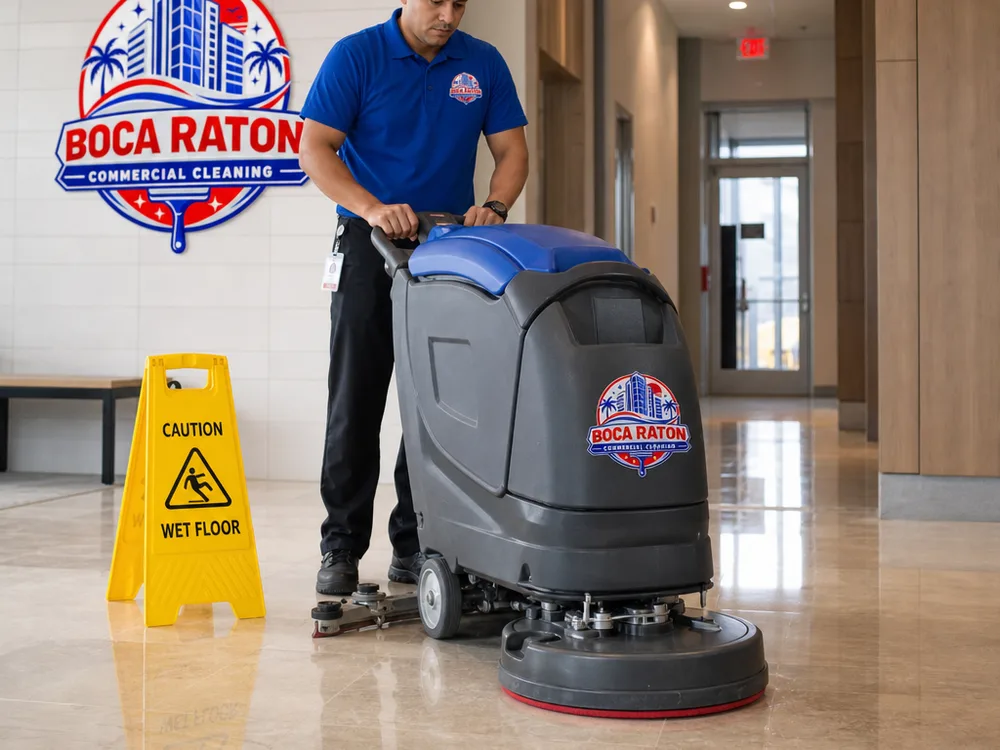
We assess matting, thresholds, and the entry floor first, because fixing what arrives is cheaper than repeatedly cleaning up after it.
Vinyl, tile, polished concrete, luxury vinyl plank, and carpet each need a different method, and testing beats assuming on a floor that may never have had a finish.
The recurring checklist holds the standard while strip and wax, grout work, and extraction sit on a dated calendar of their own.
Entry method and alarm arrangement documented, first month run as the baseline, checklist tightened where real traffic differs from the walkthrough.
The numbers
Recurring commercial cleaning here commonly runs from about $800 to $3,000 per month depending on visit frequency, square footage, and restroom count, with smaller suites often quoted per visit at $150 to $450.
Floor restoration is priced separately and by surface. Strip and wax commonly falls between $0.45 and $1.10 per square foot, scrub and recoat between $0.25 and $0.50, and carpet extraction between $0.20 and $0.40, with furniture movement and coat count driving the spread.
Worth asking
Not by cleaning alone, because a visible traffic lane usually means the finish has been abraded away rather than that the floor is dirty. That needs restorative work such as a scrub and recoat or a full strip and wax, and better matting afterwards to slow the next decline.
Yes, and it is one of the more common gaps we find. Grit collects under a mat and keeps abrading the floor beneath it, so mats get lifted and the floor underneath cleaned rather than worked around.
Yes, and the office and the unit get separate checklists. Concrete or sealed floors, dock strips, and shop areas soil at a completely different rate from an attached office, so one shared frequency always shortchanges one of them.
We identify the material and test a small area first, because a floor that looks like vinyl tile is occasionally something that must never be stripped. The method follows the surface rather than the other way round.
Weekends and after-hours windows suit most buildings, and we work in sections so a usable route stays open while an area cures. Wax coats are generally walkable within a few hours and fully cured in roughly twenty four to seventy two.
Yes, and in shared buildings that is often the whole scope. Common-area contracts cover entries, corridors, shared restrooms, and stairwells, stopping at each tenant's door unless that tenant adds their own service.
Start at the entry
Tell us your building type, the floor surfaces you have, and roughly how much area is involved. We will look at the entry first and quote the recurring work and any restoration separately.
Request a quote
Send the size, type of building, and how often you need service. We reply with a written scope and a price, and we will walk the site before anything is agreed.