
Waiting rooms and reception
The room your visitors study in detail: seating arms, counters, shared pens and clipboards, baseboards, and the floor corners a quick pass skips.
Serving Boca Raton, Florida & surrounding areas
Mon–Fri 8am–6pm · Sat 9am–2pm
Serving Boynton Beach, FL
Medical suites, retail plazas, and professional offices on a plan that still works in February, when the traffic through your door is nothing like August.
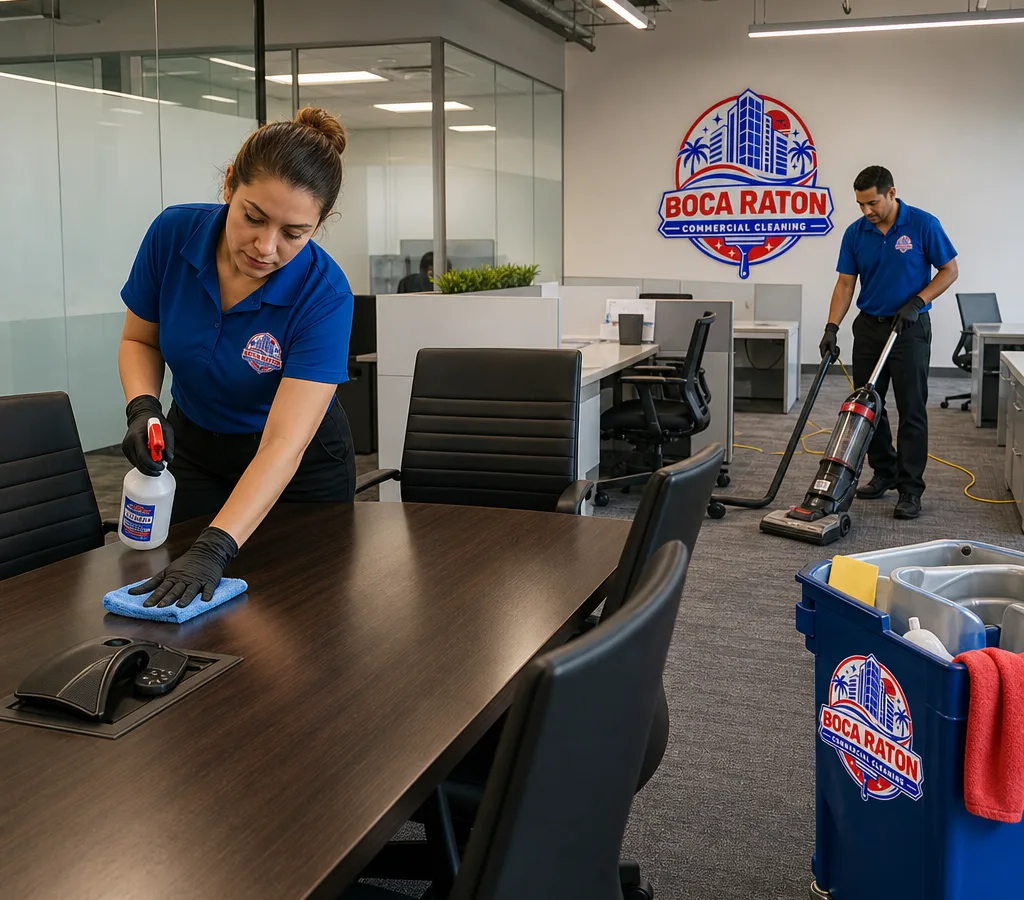
A cleaning plan sized for a quiet August is the plan that fails in February. Season is the variable here, not square footage.
Season changes everything
Boynton Beach carries one of the sharper seasonal swings in the county. From late fall through spring, waiting rooms fill, retail plazas along Congress Avenue and Boynton Beach Boulevard run at a different volume, and restrooms that coped easily in summer empty by mid-afternoon.
Nothing about the building changed. The frequency did, and a contract written against a quiet month quietly becomes inadequate without anybody renegotiating it. The usual symptom is not dirt: it is dispensers running out and floors looking tired by Thursday.
Medical and dental demand is a large part of the commercial market here, and those suites are judged in the waiting room. Patients sit still for twenty minutes with nothing to look at but the baseboard, the chair arm, and the corner of the floor, which is exactly where a rushed visit shows.
We write the scope with season in it: a base frequency, a documented step up for the busy months, and a review point rather than an assumption that last year's plan still fits.
What Boynton Beach buildings need
The room your visitors study in detail: seating arms, counters, shared pens and clipboards, baseboards, and the floor corners a quick pass skips.
Cleaned as individual units with separated equipment and a defined sequence, rather than as part of one open-plan sweep.
Fixtures, dispensers, and floor edges on a frequency that holds through a busy season, with stock tracked against real use.
Entries, walkway glass, corridors, and shared restrooms kept presentable through trading hours rather than only cleaned after close.
Reception, meeting rooms, break areas, and floors on a plan built around how your team actually uses the space.
Baseboards, vents within reach, interior glass, and floor restoration scheduled by month so the busy season never starts from behind.
Matching the calendar
The practical approach is two frequencies, agreed in advance. A base plan covers the quieter months, and a documented step up covers roughly November through April, so nobody is negotiating mid-season while dispensers run dry.
The step up rarely needs to touch everything. Usually it is restrooms, entries, and waiting areas moving from three visits to five, while back offices and storage stay exactly as they were. Paying to clean a quiet back office more often achieves nothing.
Late summer is the right window for restorative work. Floor stripping and waxing, carpet extraction, and deep detail all need drying time and an empty room, and that is far easier to give up in August than in February.
We put the review point in the scope rather than leaving it to memory, because a seasonal plan that nobody revisits is just a plan that is wrong for half the year.

We count fixtures and note floor types, then ask what changes when the season starts. That answer shapes the scope more than square footage does.
Two documented frequencies with the specific areas that move between them, so the step up is a decision already made rather than an argument in January.
Entry method, alarm arrangement, and the order rooms are cleaned in, which matters most in medical suites where sequence controls cross-contamination.
We check the plan against what actually happened, then adjust before the next swing rather than after the complaints.
What it costs
Small professional and medical suites commonly run about $150 to $450 per visit, and recurring contracts generally fall between $800 and $3,000 per month depending on frequency and fixture count. Exam and treatment room count usually drives medical pricing more than total floor area.
Where a seasonal step up applies, we quote both frequencies up front so you can see the winter number before you commit to it. That is more useful than a single figure that only holds for part of the year.
Before service begins
Yes, and we would rather build that into the original scope than treat it as a change request. We quote a base frequency and a seasonal step up together, naming which areas move and which stay the same, so the winter arrangement is already agreed.
Yes, and they get their own scope rather than a general office checklist. Rooms are cleaned as individual units with separated equipment in a defined sequence, and regulated medical waste and sharps stay with your practice and its licensed provider.
Yes, and most Boynton Beach clients prefer it. Evening service after the last appointment is the common choice, with early mornings as the alternative where a practice runs long days.
Yes, and tracking consumption rather than refilling on a fixed schedule is the fix. When we handle consumables we stock against real usage, which means dispensers are filled ahead of demand instead of after somebody complains.
Late summer, if you can. Both need drying time and an empty room, which is far easier to arrange in the quiet months than during the season, and going into a busy winter with fresh floors is the right order to do it in.
Yes, and those are usually separate contracts: the management company covers shared entries, corridors, and restrooms while each unit arranges its own interior. We keep the scopes and billing separate so nobody pays twice.
Plan for both seasons
Tell us your building type, fixture count, and what changes when the season starts. We will quote a base frequency and a seasonal step up so you can see both numbers before deciding.
Request a quote
Send the size, type of building, and how often you need service. We reply with a written scope and a price, and we will walk the site before anything is agreed.